A young Pathan man came into a Karachi dispensary on his hands and feet. Ruth Pfau remembered that he was about her age, not yet 30, and that he moved through slime and dirt “like a dog,” as if this were the ordinary way a sick person reached help.[1]
Ruth Pfau was a German Catholic nun and physician whose accidental stop in Karachi in 1960 became a 57-year fight against leprosy in Pakistan. Her work helped build a national clinic network, treat tens of thousands of patients, and bring the disease under control by 1996.
Pfau had been on her way to India, not Pakistan. Born in Germany, she had trained as a doctor, studied gynaecology, and joined the Society of Daughters of the Heart of Mary before being sent east for mission work.[2] A visa problem kept her in Karachi, where other nuns took her to see people living with leprosy.[1][2]
One account places the visit in a leprosy ghetto behind a railway station, where Pfau saw a disabled man crawling through dirt.[3] Smithsonian’s account preserves her own memory of the young Pathan in the dispensary, moving on hands and feet as if humiliation had become routine.[1] After a brief stay in India, she returned to Pakistan and made Karachi the base for the rest of her life.[1][2]
Leprosy, also called Hansen’s disease, affects the skin and nerves and can lead to disfigurement, blindness, and disability if untreated.[3] In Pakistan, the damage did not stop with infection. Patients could be pushed out of ordinary life by fear and stigma; the BBC account cited by Smithsonian described children disfigured by leprosy who had been forced to live in cattle pens and caves.[1]
From One Clinic to a National System
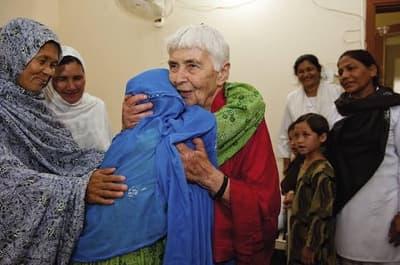
The Marie Adelaide Leprosy Centre in Karachi became the center of Pfau’s work.[1] She helped train doctors and aides there, and the effort grew into a network that reached far beyond one dispensary.[1] Smithsonian reported that the center eventually had 157 clinics across Pakistan, while The BMJ wrote that more than 50,000 patients were treated through Pfau’s efforts.[1][2]
Government cooperation came slowly, but it came. In 1979, Pakistan appointed Pfau national adviser on leprosy and tuberculosis control programs, at the rank of state secretary.[3] She later remained associated with the Karachi-based center as it extended its work to tuberculosis and other diseases of poverty.[2][3]
In 1996, the World Health Organization declared leprosy in Pakistan “under control.”[2] Pfau did not treat that as a finish line. “Leprosy elimination is successfully being achieved; however, elimination is not the end of leprosy,” she said at the time, and she continued to warn that new cases and the disabilities left by old cases still required long-term care.[1]
Pfau stayed in Pakistan for 57 years.[2] She was granted Pakistani citizenship in 1988.[1] When she died in Karachi in 2017 at age 87, Pakistan gave her a state funeral, lowered the national flag to half mast, and held her funeral mass at St. Patrick’s Cathedral before burying her in Gora Qabaristan, the city’s Christian cemetery.[2]
After the funeral, Civil Hospital Karachi, a 1,900-bed hospital affiliated with Dow University of Health Sciences, was renamed the Dr Ruth K M Pfau Hospital.[2] The traveler who had once been waiting in Karachi for a visa left behind a hospital name, a web of clinics, and the memory of a man crawling through dirt toward a door.