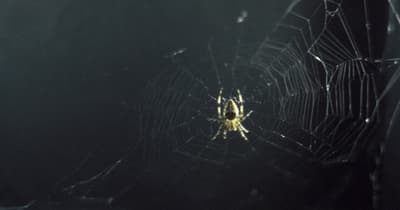
Judith Miles read a National Geographic article about spiders and found a question she wanted astronauts to answer: could a spider build a web without gravity? The high school student from Lexington, Massachusetts, entered her idea in a competition for experiments aboard Skylab. By July 1973, two cross spiders named Arabella and Anita were packed into small vials for the journey, with a fly apiece. Her proposal had become an unusually well-traveled school science project.[1][2]
The article Miles read described research in which a web could reveal how its builder was behaving. Scientists examined the spacing and arrangement of threads to study a spider's response to changes in its surroundings. Gravity helped a spider move and lay silk on Earth, so a web built aboard Skylab would give them something to examine after that familiar cue had been taken away. The astronauts would release the spiders into a box and record what they did.[1]
When the first spider entered the enclosure on August 4, it spent several days getting established, laying strands along the frame before producing an orb web. A later web looked much like the regular ones photographed on Earth. By the time the crew changed spiders later that month, the experienced resident had also become quite good at getting around. As the astronauts tried to retrieve it, it ran along its strands to evade them; the newly released spider tumbled, rotated and bounced off the frame. Researchers who watched the television footage saw evidence of an adjustment that took time.[2]
The crew also had to find something their small passengers would eat. Ground tests had shown spiders extracting juices from pieces of rare meat placed in their webs, then throwing out the shrunken residue as they would a fly carcass. That was enough encouragement to try scraps of the astronauts' food. The flight records describe fillet being offered on August 9 and August 24, then being kicked out of the web.[2]
After the mission, investigators worked through photographs and flight records that left plenty unresolved. Some pictures did not include enough of a web to measure its size, though one regular web showed a changed distribution of angles. Later webs became increasingly irregular as the animals lost weight. Anita died in space, and Arabella was found dead on the return to Earth. Thirst and starvation may have contributed, the researchers concluded, but the evidence could not separate those possibilities from other stresses aboard Skylab. The spiders had demonstrated that they could build webs in weightlessness; their deteriorating condition made the later webs harder to interpret.[2]
The astronauts returned the specimens at the end of the 59-day mission, and NASA transferred both spiders and their equipment to the National Air and Space Museum. Anita's collection record lists organic material preserved in formalin, inside a plastic vial. After traveling into orbit to answer a student's question, she came to rest in a container a little over four inches long.[3]
Sources
- Judith's Web: Student Experiment Aboard Skylab 3, NASA
- Witt and colleagues, Spider Web-Building in Outer Space, The Journal of Arachnology (1977)
- Spider, Anita, Skylab 3, National Air and Space Museum
Image: Arabella and her web aboard Skylab, 1973. NASA photograph SL3-108-1307, cropped. NASA Image and Video Library.