J. Marion Sears paid James Reavis $160 for a deed to his own property in Phoenix. The house stood in what is now downtown Phoenix. Long afterward, volunteers at the museum where it had been moved found the document recording the payment. Reavis claimed millions of acres in Arizona and New Mexico using forged Spanish records.[1]
In the 1880s, Reavis demanded payment from people with homes, businesses and railroad tracks inside the boundaries he claimed. He offered them releases, legal documents giving up his supposed interest in their property. An owner could pay him now or wait for officials to untangle the history of a Spanish nobleman's estate. Meanwhile, the threat hung over the house.[1][2]
When the Southern Pacific Railroad paid Reavis, other owners had a new reason to worry. A railway could afford lawyers. If it had decided to settle, how much chance did an individual homeowner have? John Myers Myers' account in American Heritage describes frightened residents paying up or abandoning their properties after the railroad made its arrangement. The Silver King mining company also paid.[2]
To make his demands stick, Reavis used an obligation the United States had accepted when it acquired former Mexican territory: honoring valid Spanish and Mexican land grants. Reavis supplied the missing grant himself. He built a paper history around a fictitious Spanish nobleman, Miguel de Peralta, and planted documents in archives where someone checking his story could find them.[1][2]
In Mexico, notaries certified that his copies matched records they had inspected. A person checking his papers could travel to an archive and find the matching record, right where it was supposed to be. Reavis had supplied both the claim and the evidence someone might use to verify it. He eventually married Sophia Treadway and presented her as the heir to the invented family.[1][2]
In his report on the claim, Surveyor General Royal A. Johnson described a yellow sheet pasted onto the back of a title page. Raising it had revealed added words connecting the page to Peralta. Johnson identified the fine lines of a steel pen and concluded that the writing had been added recently.[3]
On another page, Johnson compared the printed letter S with letters in eighteenth-century documents. The typography looked wrong. Johnson set the supposed royal paperwork beside other old documents and found differences a frightened landowner would have had little chance of spotting. The land claim failed in court in 1895; Reavis subsequently went to prison.[2][3]
At the Pioneer Living History Museum, volunteer Karen Chen explained Sears' payment to KJZZ by pointing to the owners' fear of losing their land and everything on it. The museum had his Victorian house. Its volunteers had also found a deed from the man who had threatened his ownership: $160 paid to James Reavis.[1]
Sources
- KJZZ: Untold Arizona, The Baron of Arizona
- American Heritage: The Prince of Swindlers
- Royal A. Johnson: Adverse report on the alleged Peralta Grant (1890)
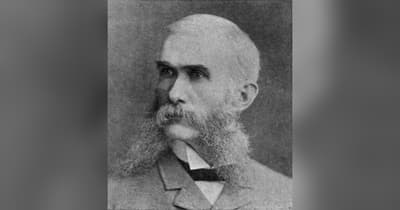
Hero: James Reavis, published in 1900. Public-domain scan via Wikimedia Commons and the Arizona Memory Project; cropped and composed for this article.