Gordon Burry and Klaus Kilor learned the rule at the Causeway, where Singapore began before the city did. They had beards, floral shirts, and hair that looked wrong to the officer at the border. Burry later said they went straight to a barber in Johor Bahru. Kilor shaved his moustache, Burry cut his shoulder-length hair, a blue suit was pressed, a clean white shirt and tie appeared, and the two men rented a chauffeured car for their second try. This time, the guard looked in and waved them through.[1]
In 1970s Singapore, Operation Snip Snip treated men's long hair as a public-order problem. Long-haired visitors could be refused entry, local men could be told to trim before reclaiming passports, and government offices later served long-haired men last.
Singapore's leaders framed hippie culture as something that traveled through records, magazines, clothing, drugs, tourism, and the small permissions of everyday style. A 2024 BiblioAsia history traces the campaign from banned songs and refused visitors to police raids, television rules, and school inspections.[1]
At the Causeway in January 1972, the policy became something a traveler could feel on his neck. The Ministry of Home Affairs tightened immigration rules so long-haired men had to cut their hair before entering, unless they were guests of the government or a respectable organisation on official business. Singaporean men were allowed back in, but some had to surrender their passports and retrieve them the next day after a trim. Nearby barbers did well. M. Kandasamy told The Straits Times he had never had such business in 20 years, stayed open late, and raised his price by 30 cents above the usual $1.20.[1][2]
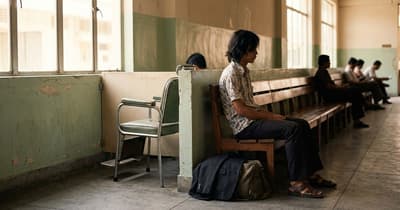
By June, the haircut rule had left the checkpoint and entered the waiting room. Government offices displayed posters in English, Chinese, and Malay saying, "Males with long hair will be attended to last." Private companies received the posters too. A man could still walk into an office with hair below the approved line, but the queue itself now corrected him before any clerk did.[1][3]
Schools and employers learned the same choreography. Boys faced regular hair inspections. Civil servants were warned about discipline. The Economic Development Board told manufacturers in 1973 that the government strongly disapproved of hiring long-haired male employees. In one shipyard case, apprentice Koh Tze Jin first resisted a haircut because he thought his hair was already above his collar. Then he shaved his head bald to avoid more arguments. His bosses read the bald head as protest and suspended him for seven days, which sent about 200 apprentices into a lunch-hour sit-in.[1][4]
The campaign kept producing new objects for people to argue over. There was the shaved head, the protest placard, the office poster, the confiscated passport, the extra 30 cents at the barber chair. Hair is almost too ordinary to govern cleanly. It grows back. It changes fashion. It lets a person comply and mock the rule with the same pair of clippers.
By the 1980s, Singapore eased up, and by 1993 even some previously banned Beatles songs were allowed again.[1] The old panic had lost its target. What remains is the image of a man standing beneath a government poster, waiting longer than everyone else because a few inches of dead cells on his head had been asked to carry the weight of a country's fear.