In 1951, Costa Rica's director of sports wanted an airport out of the way. Antonio Escarré complained about the cost of maintaining La Sabana's runway, the danger to passengers, and the engine noise endured by its neighbors. Young people needed their recreation ground back. San José had put its international airport on land already used for sport and leisure, and Escarré wanted the whole place returned to the people who came there to play.[1]
Long before the terminal opened, La Sabana had accommodated horse racing and football, along with a wooded area called the Bosque de los Niños, or Children's Forest, and an artificial lake. The open ground attracted early aviators too, whose use of the site gradually became harder to reconcile with everyone else's. When Congress approved the international airport in 1936, the preparations included cutting down the forest and draining the lake.[1]
By the time the terminal opened on April 7, 1940, Max Efinger had directed the leveling and drainage of the ground that would carry the aircraft. José María Barrantes designed the terminal in a Spanish colonial style, while French artist Louis Féron supplied its diplomatic lounge with a much more elaborate welcome than a bare waiting room: a relief mural telling the history of Costa Rica across all four walls.[2][3]
Eleven years later, Escarré made his case for removing the airport in Agustín Tin Salas's history of Costa Rican sport. Aircraft were operating beside a place where large numbers of people gathered for games, and the noise troubled the neighbors. He also invoked the wishes of Manuel Antonio Chapuí, the priest whose eighteenth-century bequest lay behind the public land. Escarré wanted young people to have somewhere to become healthy, and he was thoroughly tired of sharing it with an airport.[1]
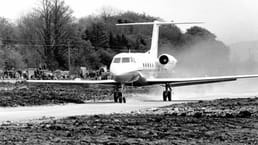
International flights eventually moved elsewhere, but domestic aviation kept La Sabana in use until early 1974. After the airport closed, football fields replaced its hangars. Culture minister Guido Sáenz later promoted a metropolitan park designed by architect José Antonio Quesada, which opened on December 8, 1977, under the slogan “La Sabana para todos”: La Sabana for everyone. By then, work had already begun on finding a use for the terminal that would let people stay a little longer.[1][2]
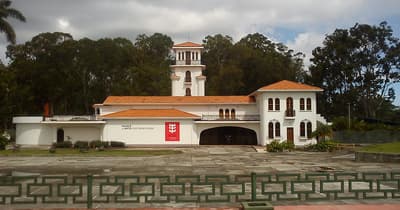
Architects Jorge Bertheau and Edgar Brenes remodeled the building between November 1977 and April 1978, preparing it for the Museo de Arte Costarricense. The museum opened on May 3, 1978. Its former airport surroundings became a park with sports fields, running and skating tracks, and a lake, while the terminal gave visitors a reason to come indoors.[2][4]
Inside the old diplomatic lounge, Féron's 1940 mural survived the change of use. The room is known as the Salón Dorado, although its reliefs are stucco painted bronze. Across the walls, the story moves from pre-Columbian life through conquest and independence, eventually reaching the great building projects of modern Costa Rica. On the south wall, it arrives at the construction of La Sabana Airport, preserved in the room where arriving dignitaries could once have admired it.[3]
Sources
- La Nación: Los mil rostros de La Sabana (2011)
- Museo de Arte Costarricense: Architectural History (archived)
- Museo de Arte Costarricense: Salón Dorado (archived)
- La Sabana Metropolitan Park: background
Image: Museo de Arte Costarricense, photographed in 2013 by Rodtico21, via Wikimedia Commons. Cropped and resized; CC BY-SA 2.0.