In graduate school, Sean Carroll and Brian Schmidt put a small bottle of vintage port in escrow with the universe. The question was not who would publish first or get a job first, but whether cosmologists would agree on the value of Omega before 20 years ran out.[1]
Brian Schmidt bet Sean Carroll that scientists would not have a reliable, agreed-upon value for Omega, the cosmological density parameter, within 20 years. Schmidt lost after the discovery of cosmic acceleration helped settle the dispute, the same cosmic acceleration work for which he later won a Nobel Prize.[1]
Carroll told the story years later while explaining a trip to Australia, where Schmidt had become an influential astronomer. The two had once been graduate-school officemates, and Carroll described Schmidt, with friendly understatement, as someone who had won the Nobel Prize "for a little thing called the acceleration of the universe."[1]
In the early 1990s, Carroll wrote, the measurements and the theory did not seem to want the same universe. Astronomers kept measuring numbers that implied an open universe. Theorists kept arguing, on what Carroll called "naturalness grounds," that the universe should be spatially flat.[1]
Omega, the cosmological density parameter, sat at the center of that disagreement. Carroll and Schmidt bought the port and set the terms simply. If cosmologists still lacked an agreed-upon value after 20 years, Schmidt would get the bottle. If they did agree, Carroll would get it.[1]
Schmidt chose the skeptical side. Carroll chose the optimistic one. That pairing would become a pattern between them, with Schmidt playing what Carroll later called the curmudgeonly experimentalist and Carroll the hopeful theorist.[1]
The bottle and the accelerating universe
The old Omega argument did not end with one side being neatly wrong. Carroll wrote that the controversy was "largely ended" by the discovery of cosmic acceleration, which showed that the two camps had each been holding part of the answer. Astronomers had measured the density of matter correctly, while the universe was still essentially flat because the remaining portion was taken up by dark energy.[1]
That result left Schmidt in the strange position of losing a bet because of the revolution tied to his own scientific fame. Carroll wrote that Schmidt conceded gracefully, then joked that King Carl Gustav had presumably consoled him on the defeat.[1]
The port was not their last wager. In 2009, Schmidt challenged Carroll again, this time over whether physicists would discover the Higgs boson at the Large Hadron Collider. In July 2012, when CERN announced a new particle, Schmidt again conceded.[1]
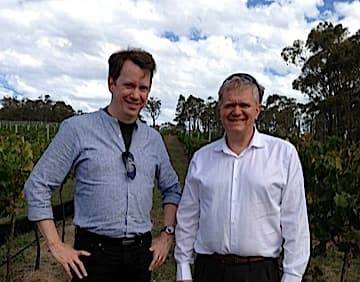
By then, the stakes had grown from a small bottle to international travel. Schmidt donated frequent flyer miles to fly Carroll and Jennifer to Australia, where Carroll gave talks. The trip included time in Sydney and Canberra, and a visit to the vineyard where Schmidt made Maipenrai Pinot Noir.[1]
The best part of the first bet is still the object at its center. A bottle of port was purchased because two young physicists disagreed about whether the universe would make itself measurable on schedule. When the answer arrived, it came with dark energy, an accelerating cosmos, a Nobel laureate's concession, and a bottle that had been waiting since graduate school.