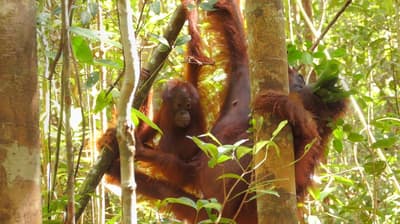
In a peat-swamp forest in Central Kalimantan, a female orangutan named Indy chewed a handful of leaves until they turned into a white, soapy foam. She did not swallow them. She rubbed the lather onto her upper left arm for about seven minutes, working it into the fur like ointment on a sore shoulder.[2]
Wild Bornean orangutans have been seen chewing Dracaena cantleyi leaves into a foamy lather and rubbing it on their bodies, apparently to soothe joint and muscle inflammation. Indigenous people in Borneo use the same plant for aches and pains.
The leaves were not part of the orangutans’ normal diet, which is why the behavior caught researchers’ attention.[1] Borneo Nature Foundation scientists had watched wild orangutans in the Sebangau National Park area since 2003, gathering more than 20,000 hours of observation, yet recorded this use of Dracaena cantleyi only seven times.[2][5]
In the recorded case, Indy made the lather, rubbed it onto her arm, and left the leaves uneaten.[2] Scientific American reported the same pattern in the broader study: orangutans chewed the plant into foam, then massaged it into their upper arms or legs, sometimes for as long as 45 minutes.[1]
Dracaena cantleyi is an unremarkable-looking shrub with stalked leaves.[1] Local people on Borneo use it to treat aches and pains, giving the orangutan behavior a strange double witness: human knowledge on the ground, and apes in the canopy preparing the same plant in a similar topical way.[1][3]
What the Plant Did in the Lab
Researchers did not stop at the resemblance. Morrogh-Bernard’s team worked with scientists from several European and Indonesian institutions to test the plant’s chemistry.[1][2] In laboratory experiments, extracts from Dracaena cantleyi were added to human cells that had been stimulated to produce cytokines, immune-system molecules involved in inflammation and discomfort.[1][3]
The plant extracts reduced production of several inflammatory cytokines, the researchers reported in Scientific Reports.[1][5] Ivona Foitová, a co-author of the study, said the pharmacological analyses showed the leaf extracts had anti-inflammatory properties.[2] The tests do not reveal what an orangutan understands. They do show that the shrub being rubbed into fur contains chemistry that could plausibly ease inflammation.
In Sebangau, adult females were the main orangutans seen performing the behavior.[2][4] Helen Morrogh-Bernard, lead author of the study and co-director of Borneo Nature Foundation, suggested they may use the plant to soothe muscles and joints strained by carrying infants while climbing through the forest canopy.[2][3] The explanation remains cautious, but the physical burden is easy to picture: a mother moving through trees with a baby’s weight clinging to her body.
A Rare Kind of Self-Medication
Animals were already known to use plants and minerals in ways linked to parasites, infections, and other conditions.[1] This case stood out because the orangutans were not simply eating a medicinal plant. They were chewing it, making a preparation, and applying it externally.
Morrogh-Bernard described the finding as the first report of self-medication in an Asian ape and, to the team’s knowledge, the first known external application of an anti-inflammatory agent in animals.[2][5] The numbers are small, which is part of the point. Seven observed episodes in more than 20,000 hours would vanish in a shorter study.[2]
The finding leaves questions in the trees. Researchers still do not know how the orangutans learn the behavior, whether younger apes copy older ones, or how many other useful plants pass unnoticed as ordinary forest greenery. For now there is Indy, chewing leaves she will not eat, making pale foam from a shrub that people also know, and rubbing it carefully into her arm.
Sources
- Scientific American, “Orangutans Use Plant Extracts to Treat Pain”
- Borneo Nature Foundation, “Orangutans, like people, use medicinal plants to treat joint and muscle inflammation”
- The Independent, “Orangutans use same medicinal plants as people to treat muscle pain”
- ScienceAQ, “Wild Orangutans Harness Medicinal Plants to Alleviate Joint and Muscle Inflammation”
- Phys.org, “Orangutans, like people, use medicinal plants to treat joint and muscle inflammation”